Waterless Frenching in lamb racks a step closer
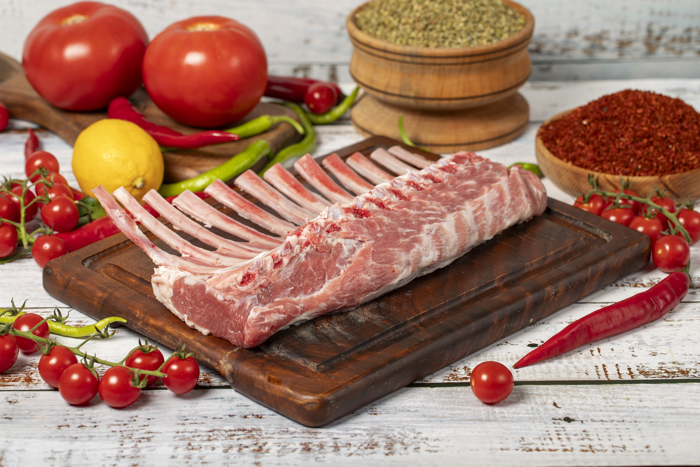
There is nothing lamb lovers treasure more than a beautifully frenched rack of lamb, but producing frenched lamb racks is resource‑intensive and processors have long been keen to find a better way.
Thanks to AMPC research, in partnership with Curious Creations, a safe, reliable and waterless alternative to manual lamb rack frenching is now within reach.
Work on improving an earlier prototype of an automated, waterless machine that can perform the task consistently, safely and efficiently is moving along.
AMPC Project Officer Advanced Manufacturing Koentadi Hadinoto said a new machine prototype had been built and tested in commercial processing plants.
“The team redesigned key components, trialled multiple versions, and ran the updated machine on thousands of lamb racks. They also worked with plant staff to test durability, speed, ease of cleaning, and day‑to‑day practicality,” he said.
Curious Creations' Jack Hercus, the inventor of the waterless frenching technology, said the improvements made to the prototype delivered a major boost in performance, lifting consistency from earlier levels of around 86 per cent to 98.5 per cent repeatability in commercial plant trials.
“This indicates that the automated process can reliably produce sale‑ready racks with minimal rework and very low rates of product damage. In addition, updates to the software appear to resolve the small number of broken rib bones observed in early testing, suggesting the system may achieve repeatability levels approaching 99.5 per cent once validated on smaller spring‑season racks,” he said.
The testing also demonstrated that the machine is reliable, durable, and cost‑efficient. Throughput reached four racks per minute, double the typical manual rate, and the continuous wire feed system proved highly reliable, with no breakages during extended operation.
“Combined with low power consumption and inexpensive filament, these results confirm that the ongoing running costs of the system are very low. Together, these findings show that the technology is suitable for continuous industrial use and can be integrated into existing production environments with minimal operator burden,” Mr Hadinoto said.
The next step would be to design and build a pilot production unit suitable for commercial application.
Mr Hercus said the development journey has not been without its challenges.
“Creating the underlying technology that makes a fully automated, waterless frenching process possible required working through a number of technical hurdles,” he said.
“AMPC’s support over the past three years has been instrumental in helping us navigate those challenges and push the system to where it is today.”
He said the technology had come a long way from the early concept stages.
"I’m excited to continue scaling the technology further to increase throughput and ensure the solution is viable for both large and small processors,” Mr Hercus said.